

Field Notes / Destination Guide
Best Photography Locations in Slovenia: A Practical Landscape Photographer's Guide
Explore 18 photo locations, from Lake Bled and the Julian Alps to the emerald Soča, with practical advice on access, seasons and light.
Explore by RegionIntroduction
In northwestern Slovenia, a few days can take you from a church on a misty hillside to the shores of Lake Bled and the emerald channels of the Soča. Work the lakes when the water is still, save the wooded gorges for overcast light, and leave time to return when the weather changes.
This guide covers 18 locations, with walking times, access information and photography notes for each stop. Most are in the northwest, around Bled, Bohinj, the Julian Alps and the Soča Valley. Velika Planina makes a separate outing for its shepherds’ huts and open pastures.
Quick answer: For a first landscape photography trip, combine Lake Bled and its viewpoints, Lake Bohinj, Peričnik Waterfall, the churches of Jamnik and Sveti Tomaž, the emerald waters of Zelenci and the Soča Valley. Allow at least five to seven days if you want meaningful flexibility rather than a hurried checklist.
Locations at a Glance
Compare all 18 photo locations
| Location | Approach | Subjects and conditions |
|---|---|---|
| Lake Bled lakeshore | Easy lakeside paths | Island church, reflections. Sunrise, calm water, autumn mist. |
| Ojstrica / Mala Osojnica | Approx. 20 / 45 minutes uphill | Elevated view of Bled. Sunrise, low cloud, clear visibility. |
| Lake Bohinj | Roadside and lakeside walks | Mountains, reflections, quieter shores. Calm mornings, autumn, soft light. |
| Savica Waterfall | Stepped path, about 20–25 minutes uphill | Powerful waterfall, woodland. Spring flow, diffuse light. |
| Mostnica Gorge | Managed walking paths from Stara Fužina | Water patterns, moss, rock detail. Overcast, spring and autumn. |
| Vintgar Gorge | 1.6 km one-way gorge; full visit 2.5–3 hours | Turquoise river, boardwalks. Diffuse light during opening hours. |
| Jamnik Church | Brief walk from permitted roadside access | Hilltop church, distant layers. Sunrise, autumn, cloud inversions. |
| Sveti Tomaž Church | Public paths and legal roadside access | Atmospheric church, telephoto landscapes. Sunrise and valley fog. |
| Peričnik Waterfall | About 10 minutes from hut when accessible | Waterfall and behind-the-waterfall view. Spring, post-rain, overcast. |
| Zelenci Nature Reserve | Around 5 minutes from designated approach | Emerald spring, mountain reflections. Early light, autumn, winter contrast. |
| Lake Jasna | Shore a few steps from parking | Mountain reflections, accessible lake. Calm dawn, blue hour, snow. |
| Vršič Pass | Roadside views; separate hikes available | High mountains and road layers. Changing clouds, autumn, summer. |
| Great Soča Gorge | Signed viewpoints, short forest paths | Emerald river and carved rock. Soft light, clear water. |
| Virje Waterfall | Short descent from approved access | Moss, pools and delicate cascades. Spring flow, overcast. |
| Kozjak Waterfall | Approx. 30 minutes from designated parking | Waterfall inside rocky chamber. Gentle light, moderate water flow. |
| Tolmin Gorges | 2 km managed circuit, approx. 1.5 hours | Deep gorge, water and forest. Diffuse light, spring–autumn. |
| Mangart Road area | Seasonal mountain road, restricted sections | High alpine panoramas. Summer, early autumn, cloud breaks. |
| Velika Planina | Cable car or chairlift plus short walk | Traditional shepherd huts, minimalism. Spring crocuses, summer, snow. |
Walking times are approximate and exclude photography stops. Confirm access with the local operators and check the Slovenian traffic information centre before taking a mountain road.
Explore by Region
Bled & Vintgar
Set aside a calm morning for Lake Bled and save Vintgar for a daytime ticket when the gorge is open.
Lake Bled Lakeshore
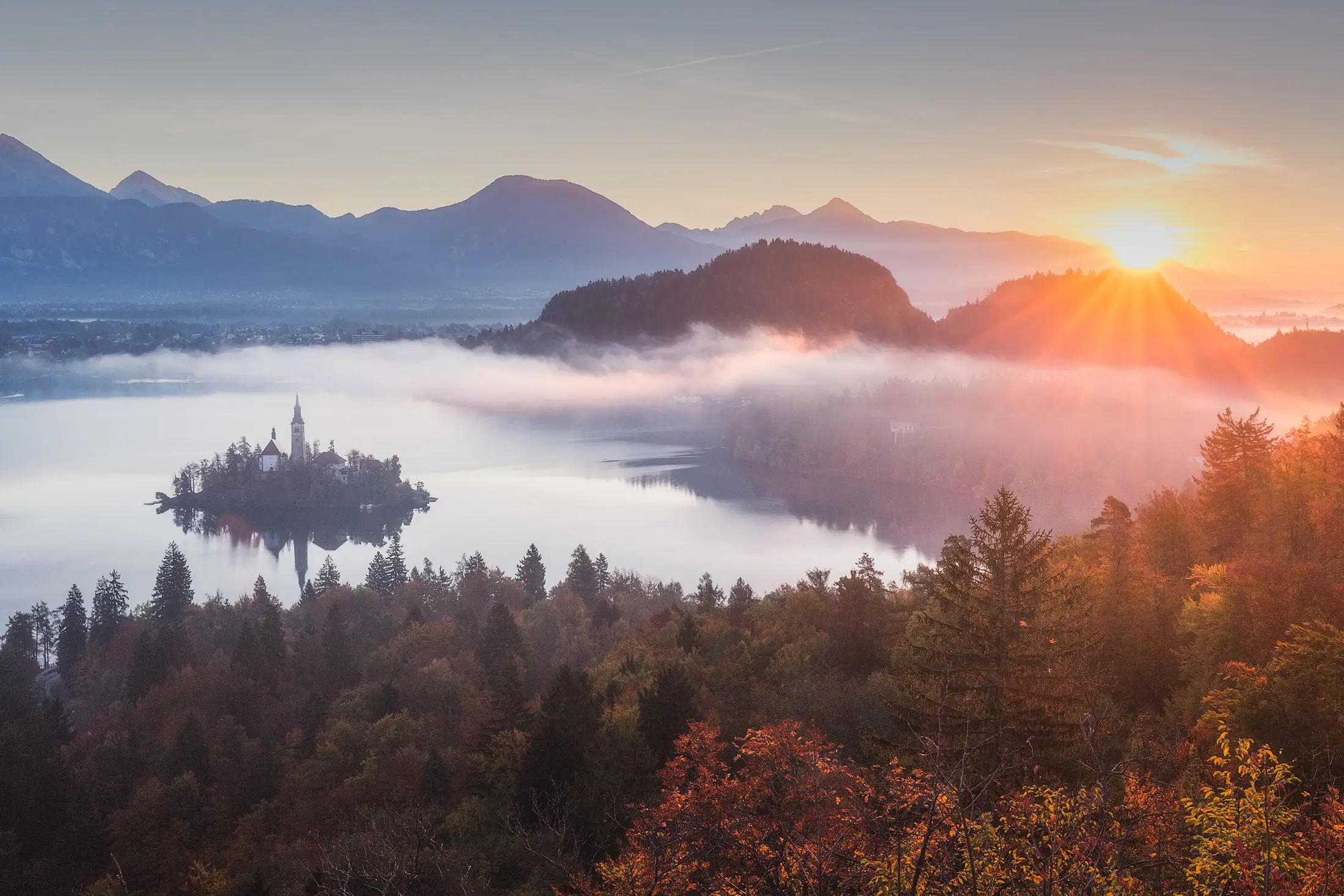
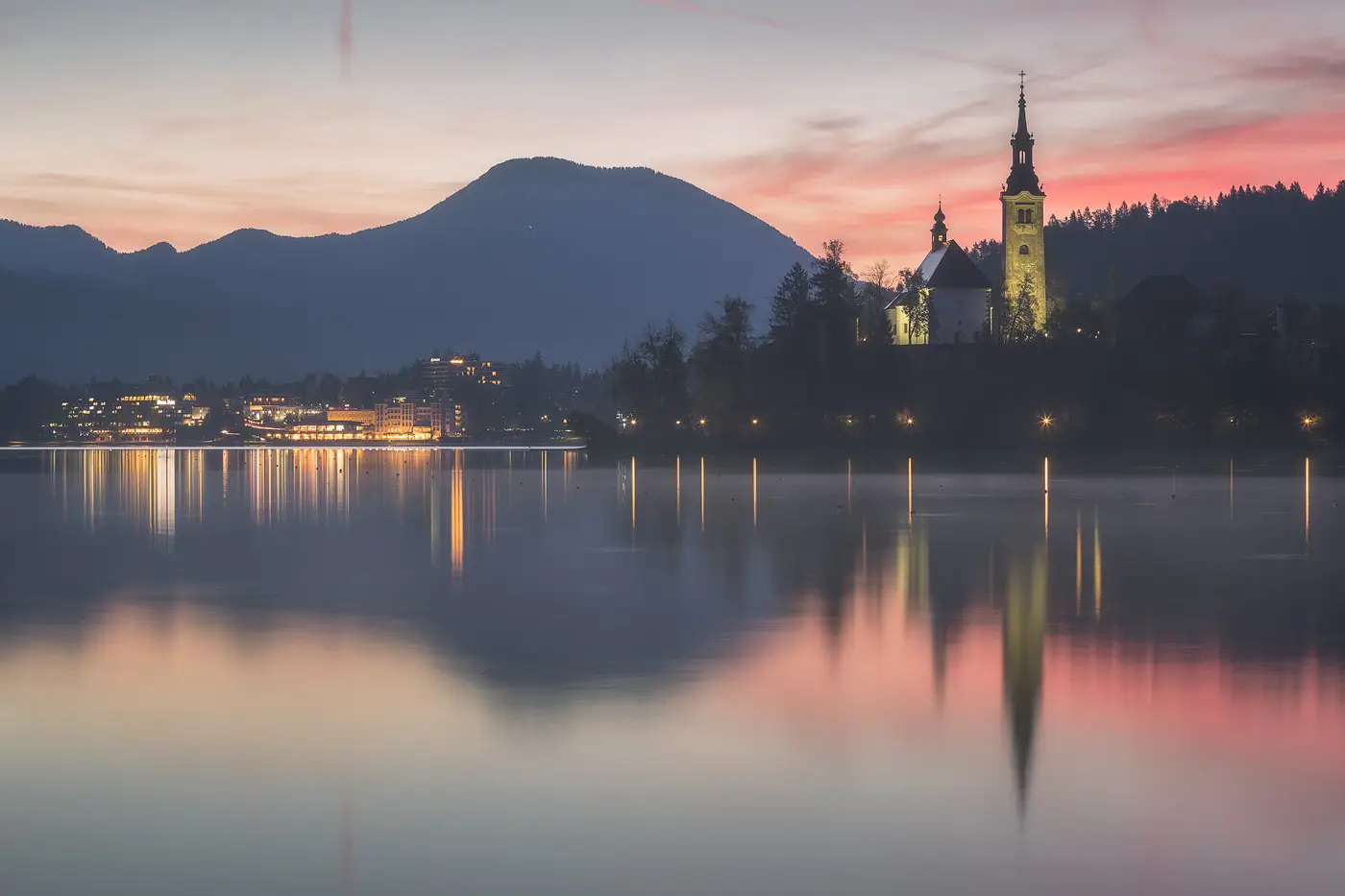
Lake Bled is Slovenia’s best-known landscape, but the classic island photograph is not the only worthwhile view. The shore offers reeds, wooden walkways, reflected mountains and changing relationships between the island church and the castle. In autumn, mist may soften the distant slopes; in winter, bare branches simplify the compositions.
- Access Bled has several official parking areas; use designated spaces and local signs. The roughly 6 km lakeside circuit is an option, but you do not need to walk all of it to find strong compositions. Choose a section of shoreline and give yourself time to work with the same scene as the light changes.
- Best time Sunrise for softer light and potentially calmer water; late autumn and cool mornings for mist. Sunset can also work, but the strongest composition depends on the shore you choose and the direction of light.
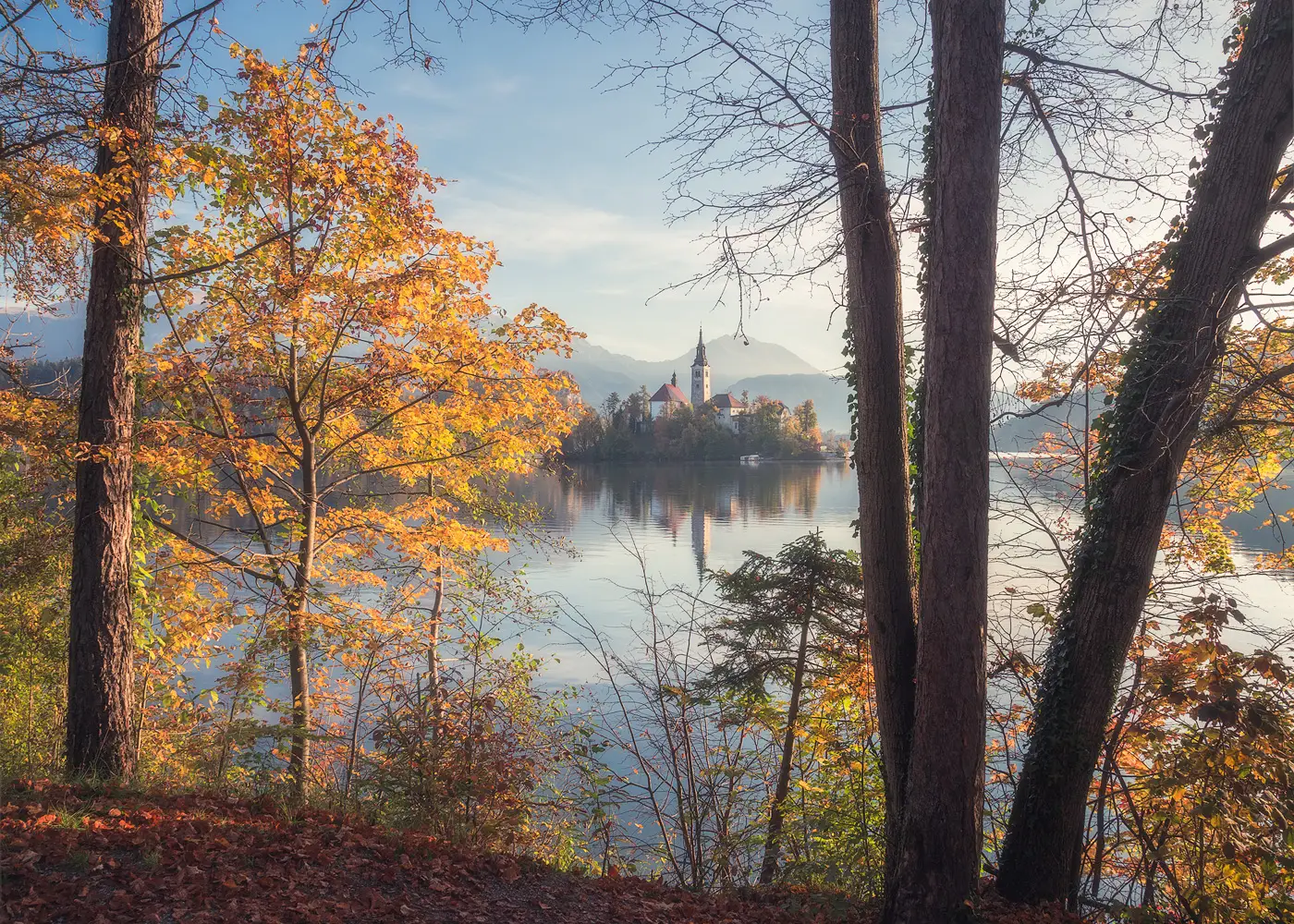
Photography notes. Use a 24–70mm lens for the island and surrounding context. A 70–200mm lens can compress the church, castle and mountains. A polarizer may help control glare but can remove reflections you actually want to keep. Check the whole frame for boats, brightly coloured objects and distracting tree branches.
Alternative: Photograph the lake from Ojstrica or Mala Osojnica, but plan these as separate uphill walks, not extensions of a flat shoreline stroll.
Good to know: Arrive with parking sorted before you set off in darkness. Do not block access to private jetties, boathouses or gardens. Lakeside surfaces can be slippery after frost.
Ojstrica & Mala Osojnica
These two viewpoints offer the elevated compositions that made Lake Bled famous. They are also easy to confuse in travel articles, even though they require different amounts of effort.
- Starting point The marked forest trails begin around the Velika Zaka / Zaka Campsite side of Lake Bled. Follow current signs and permitted paths.
- Walking The official Bled tourism board gives about 20 minutes uphill to Ojstrica, a short but steep climb. Mala Osojnica takes approximately 45 minutes uphill; extending toward Velika Osojnica takes additional walking. Treat all times as one-way and allow more time in the dark or after rain.
- Best time Early morning and sunrise. Autumn or winter mist can separate the island, shoreline and distant Karavanke mountains. Dense fog, however, can hide the lake entirely.
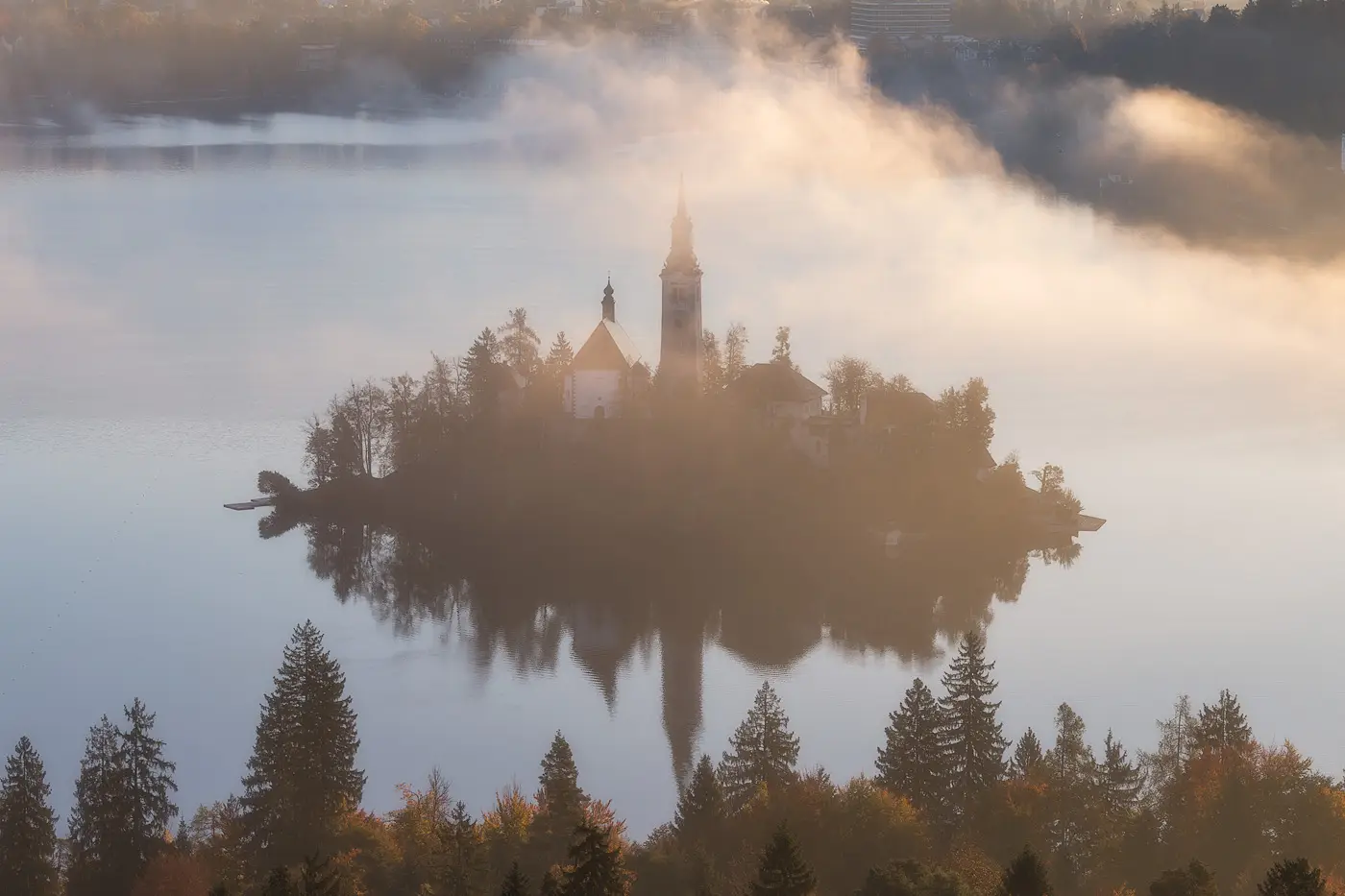
Photography notes. A standard zoom is useful for showing lake and mountains together; try a telephoto to remove distracting banks and buildings. A wide-angle view is not automatically better: the island may become too small. Check the position of the castle and island so the two subjects do not visually merge.
Alternative: When trails are wet, icy or uncomfortable in darkness, stay at publicly accessible lakeside viewpoints and save the climb for safer conditions.
Good to know: Proper hiking shoes and a headlamp are important for sunrise departures. The path is steep and has exposed or stepped sections depending on the chosen route. Do not climb onto unsafe rocks for the photograph.
Vintgar Gorge
Vintgar’s turquoise river and timber walkways photograph well in diffuse light, but it is not a place where photographers can wander freely or arrive before opening to set up a tripod. The practical details matter as much as the scenery.
- Access Ordinary visitor cars cannot park at the gorge entrance. The official system uses Central VINTGAR LIP parking, followed by the VINTGAR Shuttle, or public transport from Bled. Book a timed ticket and check the operator’s latest transfer instructions.
- Walk The gorge itself is approximately 1.6 km one way, about 45 minutes without prolonged stops. With the designated return route and transfer arrangements, allow at least 2.5–3 hours for the complete experience.
- Best time A quieter morning or late-afternoon admission within the official opening period. Diffuse light helps with the strong contrast between rocks and water. It is not a sunrise or night-photography location under normal visitor arrangements.
Photography notes. Use a manageable lens rather than spreading equipment across narrow boardwalks. A 24–70mm is a practical choice. Keep exposure times fast enough when people move through the frame; do not monopolize bridges to capture long exposures.
Alternative: Mostnica or Tolmin Gorges for different gorge environments, each with its own access rules.
Good to know: Helmets are mandatory, sturdy footwear is required, and leaving marked trails or crossing barriers is prohibited. Vintgar operates seasonally. Check the operator’s opening dates and admission times before setting out.
Bohinj
Start with the lake when the air is still. Cloud or wind can make Savica and the smaller details of Mostnica more rewarding.
Lake Bohinj
Lake Bohinj is the more spacious and less architectural counterpart to Bled. Here the mountains, forest and water usually take visual priority. Around Ribčev Laz, the church and the bridge offer a recognizable foreground; farther along the shoreline, quiet details can create simpler compositions.
- Access Reach Ribčev Laz by road and use official car parks. Other sections of the lake are accessible from designated visitor facilities, but parking regulations within the Bohinj basin are actively managed. There is no need to park on fields or along unmarked roads.
- Best time Sunrise and calm mornings, particularly when a little mist hangs above the water. Autumn combines dark evergreen forest with warmer deciduous colours. A cloudy day works well for textures and small reflections.
Photography notes. Try three scales: a broad lake-and-mountain composition, an isolated band of reflected trees, and a tight detail around the church or shoreline. A telephoto lens can be more productive than a very wide lens when the opposite side of the lake feels distant.
Alternative: Savica Waterfall and Mostnica Gorge are nearby subjects for overcast or windy days, when lake reflections are weak.
Good to know: Bohinj is partly within Triglav National Park. Respect marked paths, private meadows and local parking signs. Drone use is restricted by the park’s rules; do not assume that an open lakeshore permits flight.
Savica Waterfall
Savica is one of the best-known waterfalls around Bohinj, and it rewards photographers who use the surrounding rock and woodland to give the water context. The waterfall is powerful, but the viewing platform does not offer unlimited freedom to move around.
- Starting point The official P9 Savica Waterfall car park near Koča pri Savici. When open, the stepped path from the visitor area takes roughly 20–25 minutes uphill. Check current shuttle and parking rules and budget separately for admission.
- Best time Spring and periods with good water flow; softer light reduces harsh differences between white water and dark forest. The site has regulated opening hours, so an unrestricted dawn visit should not be assumed.
Photography notes. Try a shutter speed that retains some structure in the falling water before switching to a longer exposure. Because viewpoints may be constrained, think carefully about focal length and framing rather than trying to move outside the marked area.
Alternative: Lake Bohinj and the nearby forest provide other opportunities if the waterfall is closed owing to weather or rockfall risk.
Good to know: Trail closures may occur after heavy rainfall, ice or high water. A rain cover and microfiber cloth are more useful than an excessive collection of filters. No swimming at the falls.
Mostnica Gorge & Voje Valley
Mostnica is less about a single grand viewpoint than a sequence of water-carved rock, small cascades, pools and forest details. It is an excellent location for photographers interested in restrained colour, texture and composition.
- Starting point Use the official walking approaches from Stara Fužina, and follow the signed route into the gorge. The extension along the Voje Valley is longer and should be planned separately. Visitor fees apply during the published season.
- Distance and time There are several possible walks; do not treat a full outing to the valley’s waterfall as equivalent to a short visit to the lower gorge. Choose a route on a current trail map before setting out.
- Best time Cloudy days and autumn. Bright sun can produce patches of glare and very dark shadows, especially in narrow parts of the gorge.
Photography notes. A polarizer is particularly useful on wet rock and surface reflections. Start around 1/4–1 second for water detail, then vary according to flow. A telephoto lens can isolate elegantly curved banks and small waterfalls. Bring a cloth to dry the front element.
Alternative: Use Lake Bohinj for wider scenes and Savica if you want a more monumental waterfall subject.
Good to know: Wet roots, polished rock and narrow paths require attention. Never step beyond protective barriers or into prohibited water areas just to reduce distractions.
Hilltop Churches
Jamnik and Sveti Tomaž are small subjects in broad landscapes. Give each its own session and choose legal viewpoints in daylight.
Jamnik Church
The Church of Sts. Primus and Felician at Jamnik is a classic example of a powerful landscape subject created by scale. A small church stands on an exposed grassy ridge with sweeping views beyond it. What makes it photographically interesting is the relationship between the building, the hill and the distant mountains.
- Access Approach the Jamnik village area on public roads and use only lawful places to leave the car. Photography from public paths and roadside viewpoints often works better than walking close to the church. Never stop on blind bends or block farm access.
- Best time Early morning, especially in autumn, with low cloud in the valleys. Evening light may work for different angles and tones, but the familiar ridge composition does not require one fixed shooting spot.
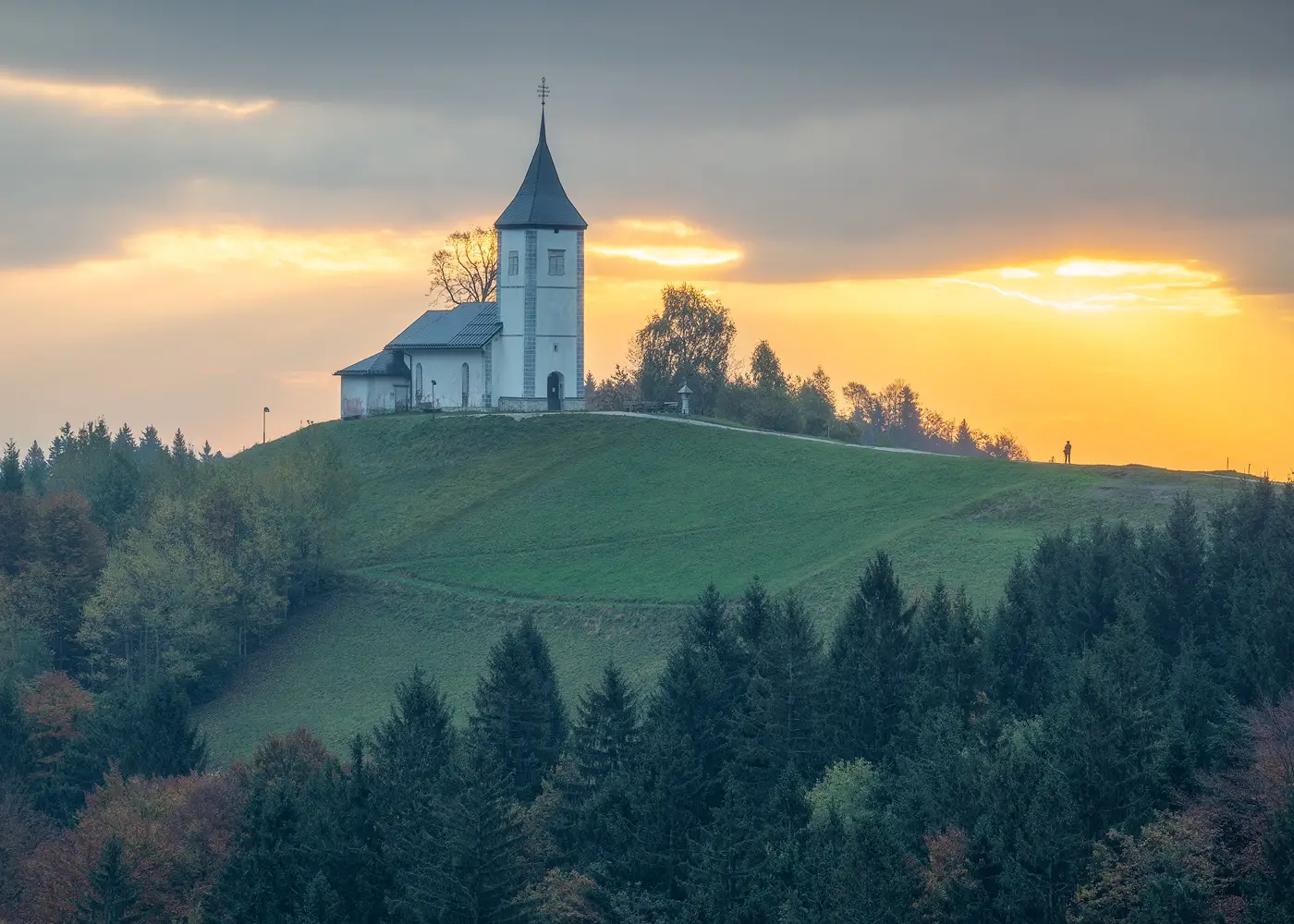
Photography notes. The telephoto lens is extremely useful here. Try different distances and heights to control how the church sits against the mountains. Watch the bell tower against busy ridgelines and leave breathing room around its silhouette.
Alternative: Nearby Sveti Tomaž is another excellent church-and-mountains subject, but the light and background relationships are different.
Good to know: Fields and slopes around the church are working agricultural land. Respect private property and avoid trampling vegetation. Use a safe pull-off and walk where access is permitted.
Sveti Tomaž
The Church of St. Thomas above the hills near Škofja Loka is one of Slovenia’s most recognizable atmospheric landscapes. It is especially compelling when fog fills the valley and separates the small church from the mountain layers beyond.
- Access The well-known distant views are approached from public roads and accessible paths around Sveti Tomaž. Use signed or clearly public paths and leave the surrounding farmland and forest clearings undisturbed.
- Best time Sunrise, particularly in autumn and cooler periods with temperature inversions. Fog is never guaranteed. Dense cloud may swallow the church; clear conditions can instead provide dramatic distant mountain detail.
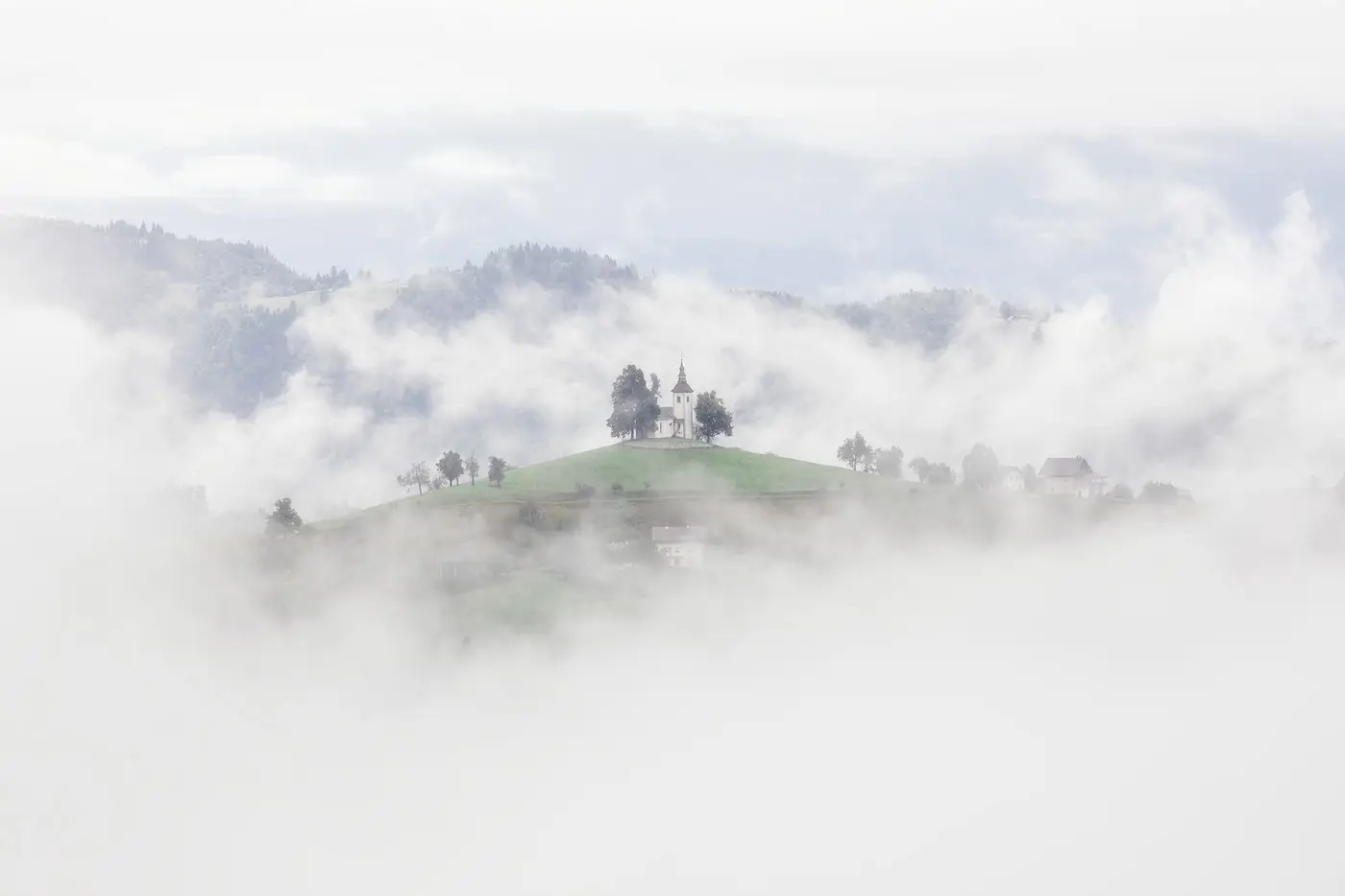
Photography notes. A 70–200mm is a strong starting point, with longer focal lengths useful for controlling the church’s relative size and the background layers. Use a tripod when low light makes slower exposures necessary. Avoid exaggerated saturation in the fog.
Alternative: Jamnik Church for a similarly architectural landscape; Lake Bled if valley cloud is too high to reveal the church.
Good to know: An area may be famous among photographers without being designated as a public viewpoint. Be considerate of residents and never cross fences or enter meadows without permission.
Julian Alps
Base yourself near Kranjska Gora for waterfall, lakeshore and high-pass sessions. Keep one low-altitude option in reserve.
Peričnik Waterfall
Peričnik in the Vrata Valley is one of the most exciting waterfall subjects in Slovenia because a marked path can, in suitable conditions, lead behind the lower waterfall. The two drops are different: the lower waterfall is about 52 m high and the upper one about 16 m.
- Starting point Koča pri Peričniku in the Vrata Valley. From the hut area, the official local guide gives about 10 minutes uphill to the lower waterfall. An alternative walk from the Slovenian Alpine Museum in Mojstrana is roughly 4–5 km one way depending on the chosen path.
- Best time Spring melt and periods after rainfall; overcast light is usually more manageable than hard sun. In winter, icicles can be spectacular but the paths may be dangerously slippery.
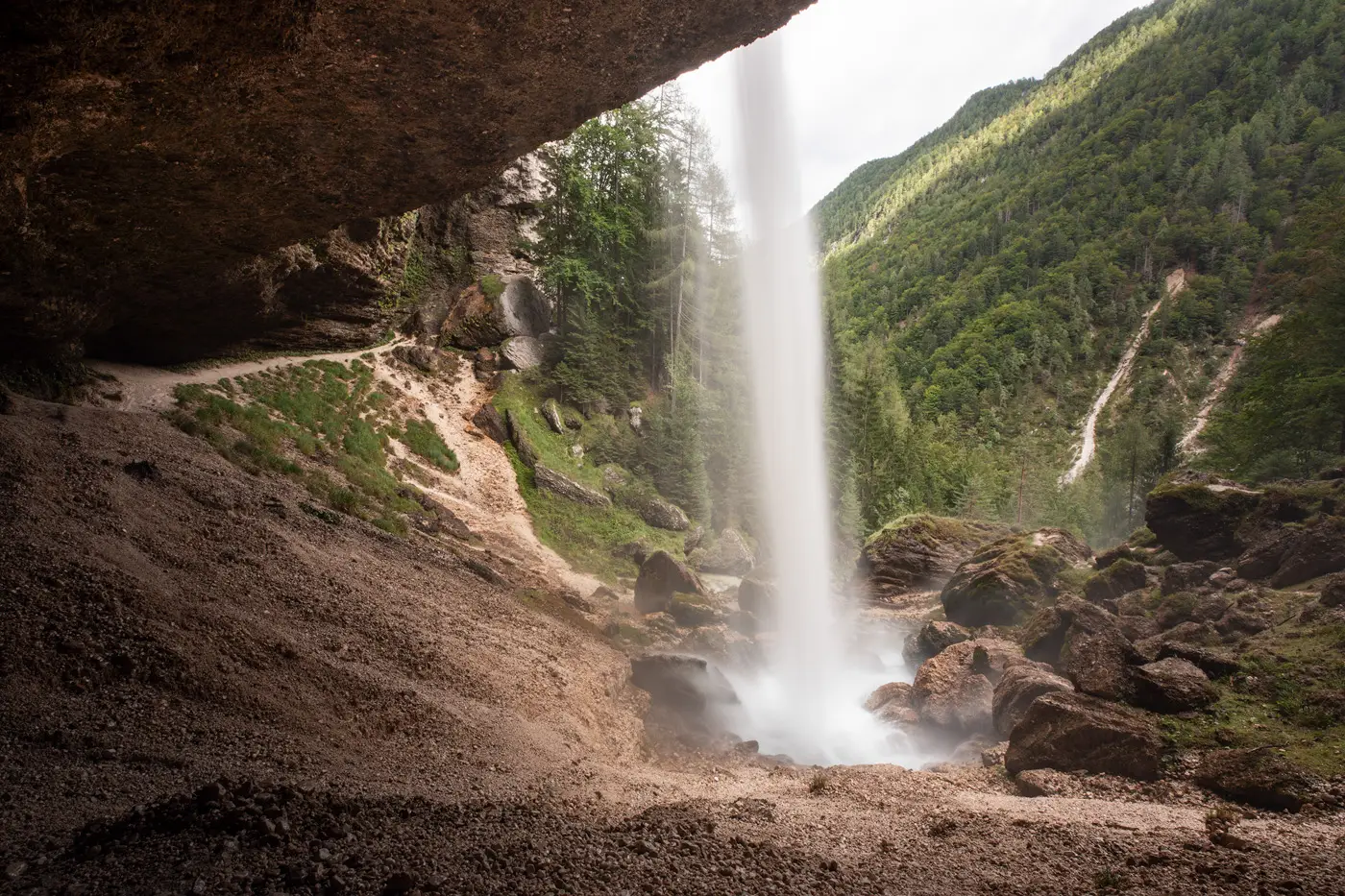
Photography notes. Begin with mid-length shutter speeds, preserving energy in the falling water. Make a second composition using the rocky overhang or forest as context. If conditions make the behind-the-waterfall trail safe and officially accessible, protect the lens from heavy spray.
Alternative: Follow the river in the Vrata Valley for quieter forest-and-water details; Savica and Kozjak are good substitutes in a broader itinerary.
Good to know: The Vrata road has seasonal access controls and winter closures. Shuttle arrangements have been offered in summer, and driving to the hut must not be assumed possible on every visit. The path behind the falls is wet, unprotected in places and inappropriate in icy conditions.
Visitor information · Vrata Valley road and shuttle rules
Zelenci Nature Reserve
Zelenci is compact but photographically rich: emerald spring water, reeds, a wooden boardwalk, woodland and mountain peaks can all contribute to a balanced frame. It is also one of the few sites in the region where winter conditions can create vivid contrasts with snow on the surrounding mountains.
- Starting point The signed access near Gostilna Zelenci, beside the main road between Rateče and Podkoren. Tourism Kranjska Gora describes approximately five minutes on foot from the roadside parking area to the reserve.
- Best time Calm early morning, autumn colours and clear winter conditions. The spring water stays relatively warm and typically does not freeze even in cold weather.
Photography notes. Use a polarizer selectively; the clear water and reflections pull in opposite directions. A standard zoom handles the boardwalk and lake, while a telephoto can simplify reeds, mountains and reflections. Be attentive to the boardwalk’s edges and other visitors.
Alternative: Lake Jasna for a more expansive lake and accessible mountain reflections.
Good to know: Stay on the wooden boardwalk and designated paths. Zelenci is protected wetland habitat, not a place to step into the reeds for a cleaner foreground.
Lake Jasna
Lake Jasna, just outside Kranjska Gora on the road toward Vršič, is an excellent option when time, weather or hiking conditions make more distant locations impractical. The two small connected lakes produce reflections of steep mountain walls and trees.
- Access By road from Kranjska Gora. The official destination guide identifies two car parks close to the lake and paths leading quickly to the shore.
- Walk Usually only a few minutes from the parking areas to public lakeside compositions. For longer walks, the paths near the Pišnica stream provide additional foregrounds.
- Best time Calm morning conditions, blue hour and autumn. Snow can simplify the scene considerably, although winter surfaces and the lakeside can be icy.
Photography notes. A 24–70mm lens covers most compositions. Try a low tripod height to bring reflections forward, but avoid placing the camera so close to the water that it becomes unstable. For minimalism, use a telephoto to isolate one reflection or rock face.
Alternative: Combine the visit with Zelenci, or with Vršič if the high road is safely open.
Good to know: The scene is popular and includes visitor facilities; careful framing may be needed to avoid busy background elements. Do not assume you can access every bank or pier privately.
Vršič Pass
At 1,611 m, Vršič is the highest road pass in Slovenia and a valuable base for photographing the Julian Alps. The winding road provides different angles, but the photographically strongest scenes depend on light, weather, safety and the exact place you stop.
- Access The pass links Kranjska Gora with Trenta on a road with 50 hairpin turns. Official parking is limited, particularly in summer. Do not stop on curves or use narrow road shoulders for photographic convenience.
- Walking There are accessible pass-side views, and numerous separate hikes. The well-known trail to Slemenova Špica is a mountain outing requiring its own route assessment, not a two-minute extension to the pass.
- Best time Summer and early autumn, especially when moving clouds reveal individual mountain faces. In winter or after snowfall, the road may be partly or fully closed.
Photography notes. Pair a wide-angle frame of the rock walls with telephoto studies of mountain layers. A cloudy sky is not necessarily poor light here; breaks in cloud can isolate a peak in a dramatic way.
Alternative: Lake Jasna for a lower-altitude landscape or the Soča Valley for colour and flowing water.
Good to know: Check current road conditions and restrictions before committing to the crossing. In season, use the designated parking and check if a shuttle fits your plans. Temperatures and wind at the top may be substantially different from the valley.
Soča Valley
From Bovec to Tolmin, changing water levels and cloud cover can shape the whole day. Check Mangart road access separately.
Great Soča Gorge
The Great Soča Gorge is a beautiful place to work with colour, texture and depth without forcing a grand mountain panorama into every frame. A long, narrow section of river cuts through pale rock and forest, creating pools of striking turquoise water.
- Access The Soča Valley tourism board locates the lower end of the gorge near the Bovec–Vršič road, about 11 km from Bovec, close to the turn-off for Lepena. The upper end has a separate roadside access area. Use marked paths, signs and approved parking.
- Walk The gorge is approximately 750 m long, but it is not accessible continuously along the river edge. Only parts can be viewed safely from the marked trail and designated viewpoints. Do not interpret the gorge length as an official walk distance.
- Best time Soft light and clear water. After heavy rain the river may be turbulent or carry sediment; in cold weather exposed rock can be slippery.
Photography notes. Try compositions where the river becomes an S-curve through the forest, then look for isolated pools and pale rock geometry. A polarizer can reveal water colour, but keep enough reflection to suggest its surface.
Alternative: Virje and Kozjak for smaller waterfall subjects; Tolmin Gorges for a managed route.
Good to know: Photograph only from permitted viewpoints. Approaching the canyon’s unprotected edges is dangerous; never descend outside the signed paths.
Virje Waterfall
Virje near Bovec is especially useful for more intimate landscape work. Its mossy banks, fan-shaped cascade and pale turquoise pool offer a different visual language from large waterfalls such as Peričnik or Savica.
- Access From Bovec toward Plužna, follow the signposted approach to Virje. A short path descends to the waterfall from the designated access area. Other longer trails from Bovec are possible, but should not be confused with the short approach.
- Best time Early spring or periods of good water flow. Overcast conditions make it easier to control contrast between the green pool, dark stones and white water.
Photography notes. Use 1/8–1 second as a starting point for silky water while retaining some texture; adjust to the actual flow. A polarizer can reduce wet-rock reflections. Try vertical compositions with dark forest edges framing the falls.
Alternative: For an extended outing, visit the Glijun spring area using permitted paths, or combine Virje with the nearby Soča River.
Good to know: Parking fees and restrictions may apply, and motorhomes and buses have been excluded from the closest access. The bank is slippery; do not enter the pool or climb into restricted areas.
Kozjak Waterfall
Kozjak has a distinctive character: a narrow stream falls into a pool enclosed by a dark rocky chamber. The waterfall itself is not enormous; the composition becomes powerful because the chamber directs the viewer toward the light and water.
- Starting point Use designated parking beyond the Napoleon Bridge area near Kobarid, following signs for Kozjak. The Soča Valley tourism board gives approximately 30 minutes on foot from the parking area to the waterfall.
- Best time Soft daylight, especially when the bright waterfall and dark walls have manageable contrast. Spring and autumn can provide attractive flow and foliage.
Photography notes. A 16–35mm or 24–70mm lets you include the chamber. Meter carefully for the brightest water and check that the shaded rock has enough information. An exposure bracket may be useful when the light difference exceeds your sensor’s practical latitude.
Alternative: Peričnik for a larger waterfall and Virje for softer moss-and-water images.
Good to know: Access is managed during the visitor season and admission fees apply. Opening times may exclude sunrise and sunset access. Do not leave the permitted walkway to reach the water.
Tolmin Gorges
Tolmin Gorges provides a varied sequence of emerald water, steep paths, exposed rock and forest. It can be a productive photography session, but the route is more physically demanding than a casual roadside stop.
- Access The operator lists P1, a paid car park closest to the entrance, P2, a free car park with around 15 minutes of additional walking, and P3, a free option requiring around 30 minutes walking. A seasonal shuttle operates from some parking areas.
- Walk The managed visiting circuit is approximately 2 km and 1.5 hours, with around 500 steps. This excludes time spent photographing. The path is steep in places and slippery after rain.
- Best time A quiet, diffuse-light session within opening hours. Spring and autumn are excellent for foliage and water, though weather can affect safety and access.
Photography notes. Shoot sequences of smaller scenes. A moderate telephoto isolates turquoise pools against dark rock; a standard zoom handles the larger canyon views. Keep tripod legs out of walking corridors.
Alternative: Vintgar and Mostnica each offer different gorge subjects; their admission systems and walking requirements are not interchangeable.
Good to know: Use only designated paths and respect closures and timed admissions. Carry good footwear and a waterproof layer. If the gorge is closed because of flooding or rockfall, do not try to enter from another side.
Mangart Road Area
The Mangart area offers remarkable rock faces and borderland mountain scenery. It is a tempting destination for sunset and alpine panoramas, but access conditions are more important here than at almost any other location in this guide.
- Access Road access is seasonal and can change because of snow, rockfall, repair works and restrictions. Official barriers can close upper sections to drivers, cyclists and people on foot. Check current notices before leaving, and stop at signed limits. Access and parking charges may apply.
- Best time During an officially permitted summer/early-autumn access window, with stable mountain conditions and interesting cloud movement.
Photography notes. Prioritize shapes, overlapping ridges and changing sunlight rather than pushing toward a closed section. A telephoto is ideal for distant peaks and cloud layers; use a wider lens only when you have a meaningful foreground from a safe permitted location.
Alternative: Vršič Pass when road and weather conditions are better; Lake Jasna or the valleys if high elevation is unsafe.
Good to know: Do not assume the road is open based on last season’s reports. The road is narrow and exposed, with a limited number of cars permitted in the managed area. The condition of the exact route and access barrier must be checked immediately before travel.
Velika Planina
Make this a separate outing. Plan around the lift timetable and leave enough time for the return.
Velika Planina Shepherds’ Settlement
Velika Planina is the one location in this guide outside the Bled–Bohinj–Soča core that I would especially consider for its different visual style. Traditional shepherd huts lie across a rolling plateau, creating opportunities for clean shapes, repeating forms, snow scenes and minimalist composition.
- Access The standard visitor approach is the cable car from Kamniška Bistrica, followed by a chairlift or a marked walk across the plateau. From the upper cable car station, the official operator suggests roughly 45–55 minutes on foot to the shepherds’ settlement, depending on the chosen path; from the upper chairlift arrival, around 10–15 minutes.
- Best time Spring crocuses, summer pastures and winter snow. Conditions and grazing activity differ from one season to another.
Photography notes. A 70–200mm is useful to isolate individual huts against clean grass or snow, while a standard zoom can show hut groups and the background mountains. Look for gentle curves in the terrain and low fog that separates near and far huts.
Alternative: If you are based near Bled and have limited time, Jamnik or Sveti Tomaž provide architectural landscapes with less logistical diversion.
Good to know: The cable car and chairlift operate seasonally and can close for maintenance. Check current operating hours and the last descent before planning a dawn or evening session. Respect working shepherds and private huts, and stay on permitted paths.
When to Photograph Slovenia
Spring: Waterfalls, Fresh Greens and Snow on the Peaks
March through May can be excellent for waterfalls and river valleys, especially after snowmelt and rain. The forests become progressively greener while high passes may still be snowy or closed. Spring is not automatically suitable for Vršič, Mangart or exposed alpine hikes. Prioritize Peričnik, Virje, Mostnica and accessible lakes when high mountain access is uncertain.
Summer: High Passes and Early Starts
June through August brings long days, mountain access during suitable weather and fully active visitor systems. Early starts help with Lake Bled and other popular locations; midday light can work well for deep gorges where sunlight is heavily filtered. Expect traffic and timed visitor entry at certain managed attractions.
Autumn: Forest Colour and Valley Fog
September and October are exceptionally versatile. Bled, Bohinj, Jamnik, Sveti Tomaž and the surrounding forests can produce layered compositions and low fog. The actual colour peak depends on elevation and weather, and high passes can become wintry unexpectedly. Build the itinerary around flexibility rather than a guaranteed foliage date.
Winter: Snow, Simplicity and Reduced Access
Snow creates attractive clean shapes at Velika Planina and around the lakes, while waterfalls may develop striking ice formations. But ice, closed visitor routes and inaccessible mountain roads are genuine hazards. A winter photographer should concentrate on verified accessible locations rather than attempt summer routes in winter clothing alone.
For woodland compositions in mist and soft light, see Forest Photography: Finding Mood and Atmosphere Among Trees.
Sunrise and Sunset in Slovenia
Approximate sunrise and sunset times for Ljubljana on the 15th of each month, in local time (CET or CEST), rounded to five minutes using the NOAA solar calculation method. A mountain horizon can delay the first direct light or cut an evening short. Check the exact date and location before travelling.
| Month | Sunrise / sunset | Field note |
|---|---|---|
| January | 07:40 / 16:40 | Short daylight; icy approaches possible |
| February | 07:05 / 17:25 | Winter light, gradually longer days |
| March | 06:15 / 18:05 | Check DST change late in month |
| April | 06:15 / 19:45 | Waterfalls and spring greens |
| May | 05:30 / 20:25 | Very early morning departures |
| June | 05:10 / 20:55 | Long days; allow for late-evening return |
| July | 05:25 / 20:50 | Popular routes can be busy |
| August | 06:00 / 20:15 | Early mist and summer mountain light |
| September | 06:40 / 19:15 | Increasing chances of cool mornings |
| October | 07:15 / 18:20 | Autumn colours and inversions |
| November | 07:00 / 16:30 | DST ended; short afternoon light |
| December | 07:35 / 16:15 | Very limited daylight and winter risks |
Where to Stay
Bled makes a convenient base for the lake, the Osojnica viewpoints, Vintgar, Jamnik and Sveti Tomaž. Bohinj is better for the larger lake, Savica and Mostnica, and for quieter evenings near the Julian Alps. Kranjska Gora suits Zelenci, Lake Jasna, Vršič and Peričnik. Bovec or Kobarid works well for the Soča Valley, including Virje, Kozjak and the river gorges.
For a trip of five to seven days, I would avoid changing accommodation every night. Use two bases if possible, and treat one well-chosen morning location as more valuable than three hurried roadside stops. Leave at least one flexible session for mist, rain or unexpected cloud conditions.
Be aware that the mountains separate valleys. A route that looks short on the map may involve a high pass, seasonal closure or slow roads. Vršič and Mangart must never be treated as guaranteed year-round driving shortcuts.
A 5–7 Day Photography Itinerary
Days 1–2: Bled, Ojstrica, Jamnik and Sveti Tomaž. Use sunrise for one elevated or atmospheric composition and leave daytime for exploring alternative angles. Do not plan two dawn locations at once; each deserves time and a weather-dependent decision.
Days 3–4: Bohinj, Savica, Mostnica and Vintgar. Organize the gorges around admission times rather than forcing them into a sunrise/sunset schedule. Choose Lake Bohinj for calm water or broader mountain scenes.
Day 5: Peričnik, Zelenci and Lake Jasna. This day works best with a base in Kranjska Gora. If the Vrata road is restricted, use the official shuttle or plan a longer walk; do not improvise from closed roads.
Days 6–7: Vršič and the Soča Valley. Use the pass only if open and appropriate for the vehicle and weather. Include one or two from Great Soča Gorge, Virje, Kozjak and Tolmin Gorges rather than attempting them all without time for photography. Mangart requires a separate conditional access decision and should not be treated as a guaranteed stop.
With more time, add Velika Planina as an independent day or overnight extension.
What to Pack
16–35mm: Strong for the interior space of Kozjak, for certain mountain compositions and for broad river bends, but it can make distant peaks tiny. 24–70mm: A practical primary lens for the diverse locations in this guide. 70–200mm: Highly useful for Jamnik, Sveti Tomaž, layered forests and the geometry of the Julian Alps. For an atmospheric and minimalist style, the telephoto may be the most important creative tool.
A circular polarizer helps in the gorges and around waterfalls, but do not remove every reflection without thinking about the scene. A modest ND filter may be useful for slow water in strong light; it is not essential at every stop. A stable tripod, rain cover, microfiber cloths and a headlamp are useful, provided that tripods are allowed and do not obstruct managed trails or walkways.
For early starts and variable mountain weather, pack windproof and waterproof layers, suitable footwear, a charged phone with offline maps, water and a small first-aid kit. In spring and autumn, lake temperatures and hilltop temperatures can feel very different from the valley forecast. For winter mountain travel, seek current local conditions and specialist equipment where required.
Common Planning Mistakes
- Confusing a place coordinate with a parking coordinate. A GPS pin in the middle of a lake, canyon or mountain pass is not a legal driving destination.
- Treating short walks and full outings as the same route. The Vintgar gorge walk is short, but the managed round experience takes hours.
- Assuming every viewpoint is available at sunrise. Ticketed gorges and seasonal cable cars have opening times.
- Driving to high passes without checking conditions. Mountain roads can close or end before the destination shown on a map.
- Photographing from private fields. Churches can be seen from public roads without walking across agricultural land.
- Using a polarizer automatically. It can eliminate the very reflection that makes a lake composition work.
- Planning a fixed schedule around fog. Inversions help atmospheric images, but sometimes the entire subject disappears.
- Taking no time for photography. Ten locations in a day may look productive but seldom produce ten strong photographs.
Slovenia Photography FAQ
What are the best photography locations in Slovenia?
For a first visit, Lake Bled, Ojstrica, Lake Bohinj, Peričnik, Jamnik, Sveti Tomaž and the Soča Valley cover an excellent range of landscapes. Vintgar, Kozjak and Tolmin are strong options for water and woodland photography during their opening seasons.
How many days do I need for Slovenia landscape photography?
Five to seven days allow several meaningful sessions in the northwest with some flexibility. Seven to ten days are preferable if you want to include multiple weather-dependent sunrise locations, the Soča Valley and a wider itinerary.
When is the best time to photograph Slovenia?
Autumn is excellent for foliage and mist, while spring is often rewarding for waterfalls. Summer gives wider high-mountain access but brings longer days and more visitors. Winter is attractive for minimalism and snow, with more access constraints.
Is Lake Bled better at sunrise or sunset?
Both can work from different viewpoints, but sunrise is a strong starting choice for reflections and potentially atmospheric conditions. The shore and elevated viewpoints have different light directions and walking requirements.
Can I photograph Slovenia without hiking?
Yes. Lake Jasna, parts of Lake Bled and several road-accessible valley locations offer good opportunities. Ojstrica, Savica, Peričnik, the gorges and mountain viewpoints require walking or managed visitor access.
Do I need a car to photograph Slovenia?
A car makes a flexible landscape photography itinerary much easier, especially for early morning sessions. Public transport, seasonal shuttles and cable cars cover some popular sites, but timetables often do not align with sunrise.
Can I use a drone in Triglav National Park?
Do not assume drone flights are permitted. Triglav National Park and individual attractions have restrictions, and Slovenian/EU drone rules also apply. Check the national park’s visitor code and the aviation authority’s rules before considering a flight.
Are Vintgar Gorge and Tolmin Gorges open all year?
Both gorges operate seasonal admission and may close in adverse weather. Check the Vintgar visitor information and Tolmin Gorges access information for your travel date.
Leave Room for the Light
The strength of Slovenia as a photographic destination is not how many landmarks you can see in one day. It is the variety of small, photographically meaningful decisions available within a relatively compact area: a telephoto lens isolating a church above mist, a polarizer revealing a riverbed, or an early morning spent waiting for a reflection to settle.
Plan the access and the safety details carefully, leave room for weather, and allow the landscape to surprise you. Those choices will often matter more than an ambitious list of photo stops.
Explore with OutdoorPhotoDream
Group Photography Tours
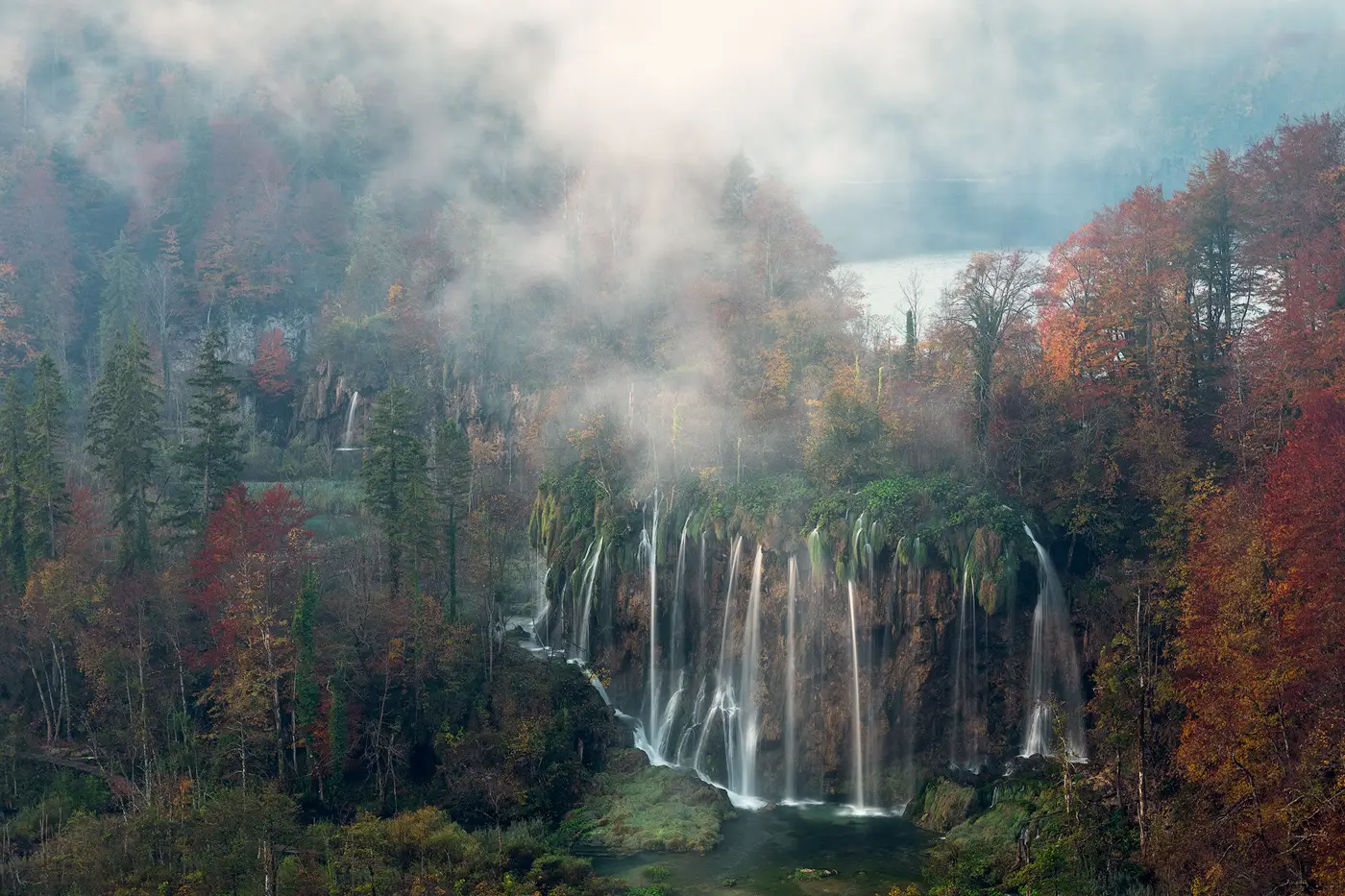
Slovenia & Croatia Autumn Photography Tour
Photograph Slovenia’s alpine landscapes alongside the waterfalls and autumn forests of neighbouring Croatia on a small-group journey.
Explore Photo Tour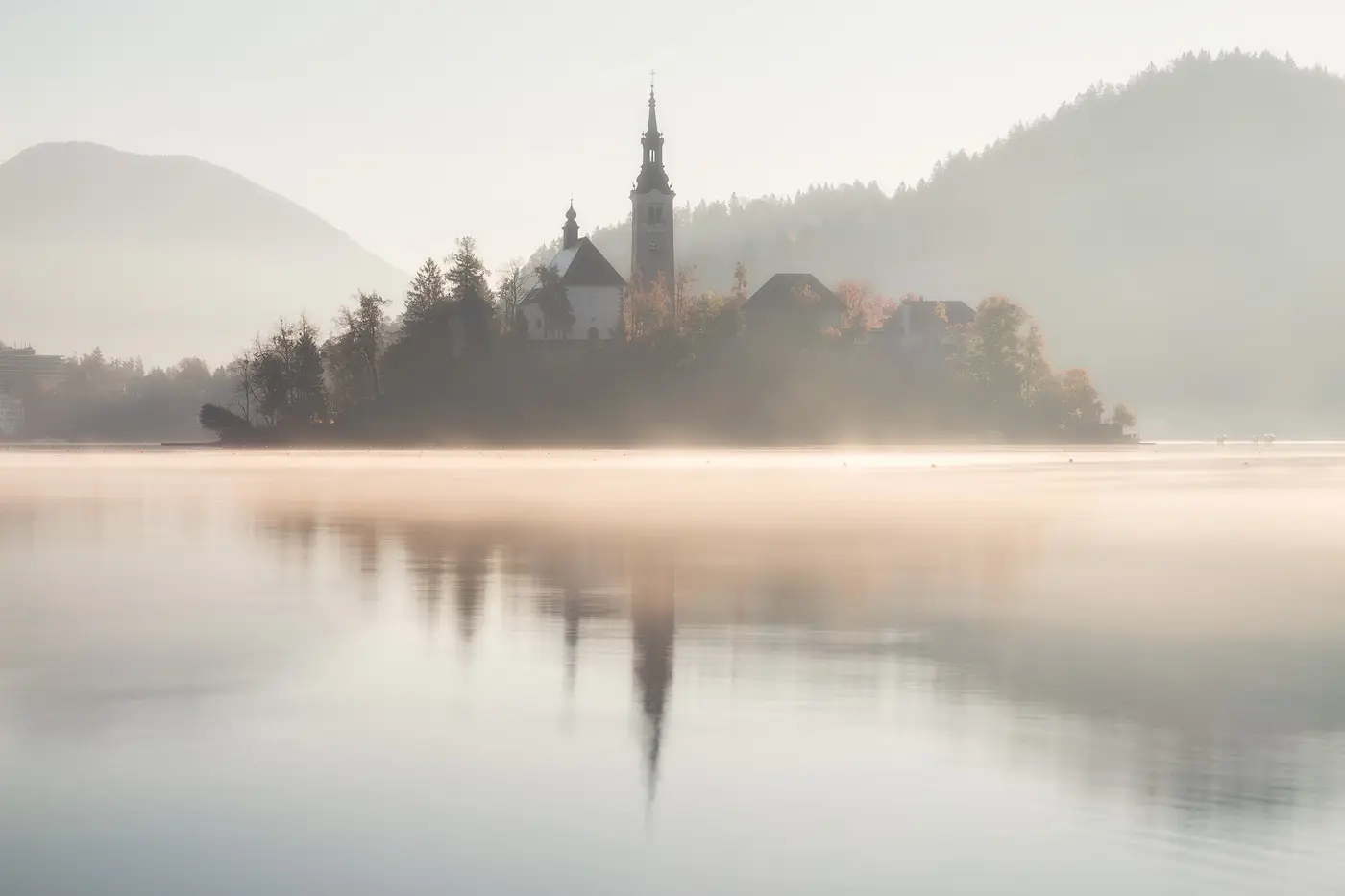
Private Tours
Private Slovenia Photography Tour
Plan a private multi-day journey through Slovenia around the locations, pace and photography subjects that interest you.
Explore Private Tour
Group Departures
All Photography Tours
Browse small-group photography tours in the Dolomites, Iceland, Patagonia and other destinations.
Explore All Photo Tours
About the author
Federico Antonello
Related Field Notes

Best Photography Locations in Iceland: A Practical Landscape Photographer’s Guide
Explore 18 Iceland photography locations and four Highland stops, with realistic walking times, seasonal light, and practical advice for planning your route.
Forest Photography: Finding Mood and Atmosphere Among Trees
Discover how to create mood, depth and atmosphere in forest photography. Learn to work with light, weather and composition to capture the magic of woodland landscapes.


