


Field Notes / Mountain Skills
Via Ferrata for Beginners: What It Is, What You Need & How to Start
What to expect from your first equipped route, how to read the grades, and what to ask a qualified mountain guide before you go.
Guide ChaptersIntroduction
The first time you see a via ferrata, it can look both irresistible and intimidating: a steel cable disappears around a cliff, metal rungs climb a rock face and, somewhere above, people move through a landscape that seems impossible to reach on a normal hiking trail.
Perhaps your first question is simple: Could I do that?
Some hikers can try it on a suitable introductory route with professional instruction. Even where there is a steel cable, a fall can cause serious injury. Understanding the difference is the best way to discover whether this kind of mountain adventure is for you.
This beginner’s guide explains what a via ferrata actually is, how difficult it can be, what equipment is essential and how to approach your first route responsibly—especially in the Dolomites, where these protected mountain routes form a distinctive part of the landscape.
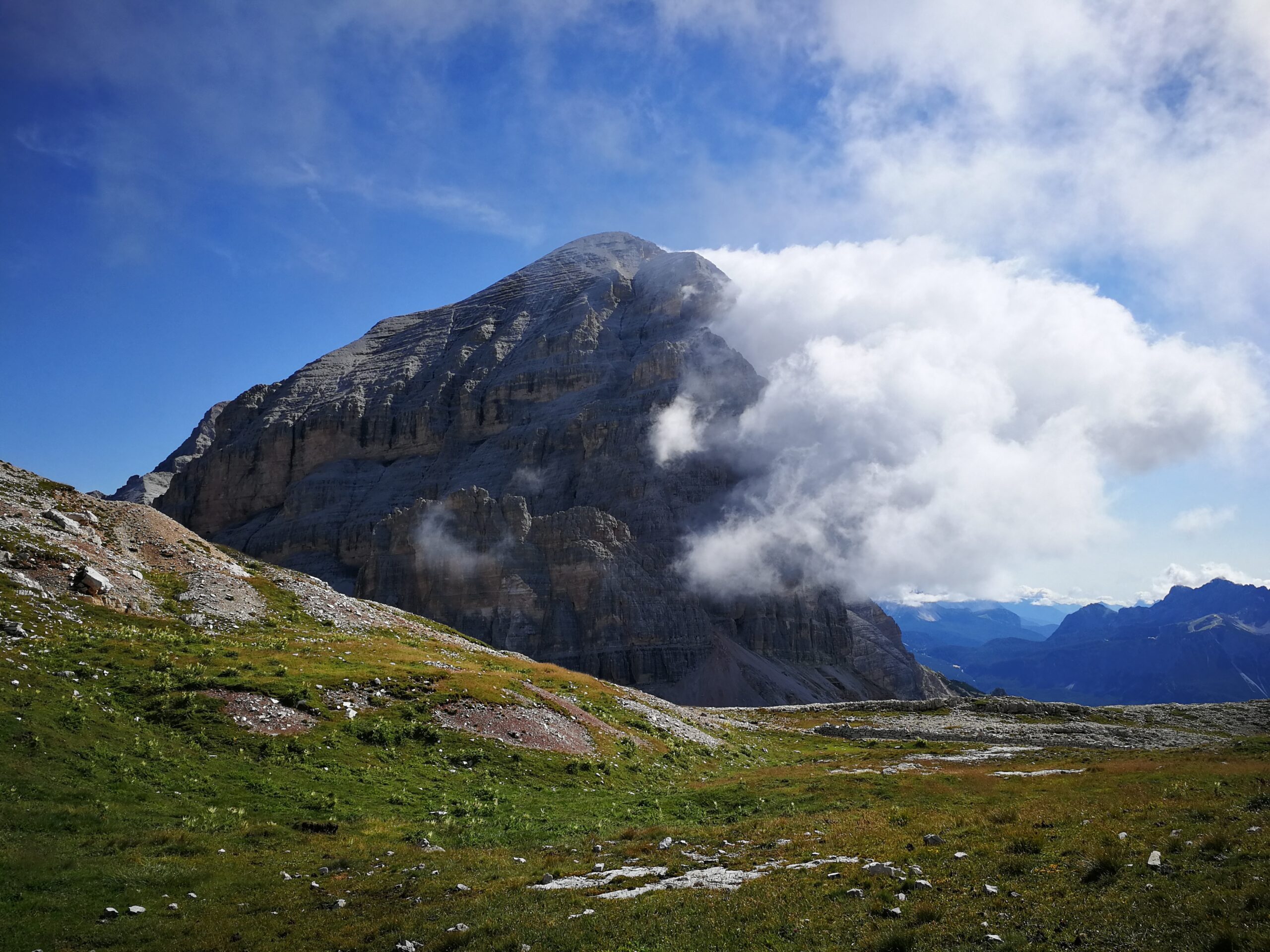
Cover photograph of Piz de Lech by Matija Podhraški, public domain via Wikimedia Commons. The photograph shows equipped terrain and is not a suggested first route.
Your First Ferrata at a Glance
- Start with instruction. Book a qualified guide or practical introductory course and describe your experience, fitness and comfort with heights.
- Look at the whole day. Check the approach, cable sections, exposure, descent, possible retreat and weather.
- Confirm the kit. Ask whether an inspected helmet, harness and certified ferrata set are provided and suitable for each participant.
- Keep a lower option. Change the plan if the route is closed, thunderstorms are forecast or conditions are beyond your group’s ability.
Guide Chapters
What It Is
Via ferrata is Italian for “iron path.” It describes a mountain route equipped with fixed aids such as steel cables, ladders, rungs, steps or bridges. Some routes follow rocky ledges and ridgelines. Others climb steep or nearly vertical rock faces.
The equipment installed on the mountain helps people progress through terrain that would otherwise require more technical climbing skills. Participants normally wear a climbing harness and helmet and use a dedicated via ferrata lanyard with an energy absorber to connect to the fixed safety cable. The International Climbing and Mountaineering Federation (UIAA) identifies these as fundamental elements of the activity. UIAA: Via Ferrata
Think of via ferrata as an activity between mountain hiking and technical climbing, but with its own techniques, equipment and risks.
The boundaries can blur. An equipped path (sentiero attrezzato) might contain only short protected sections, while a full via ferrata can involve sustained vertical climbing. Both require careful assessment. A small amount of cable on a route does not tell you its full difficulty.
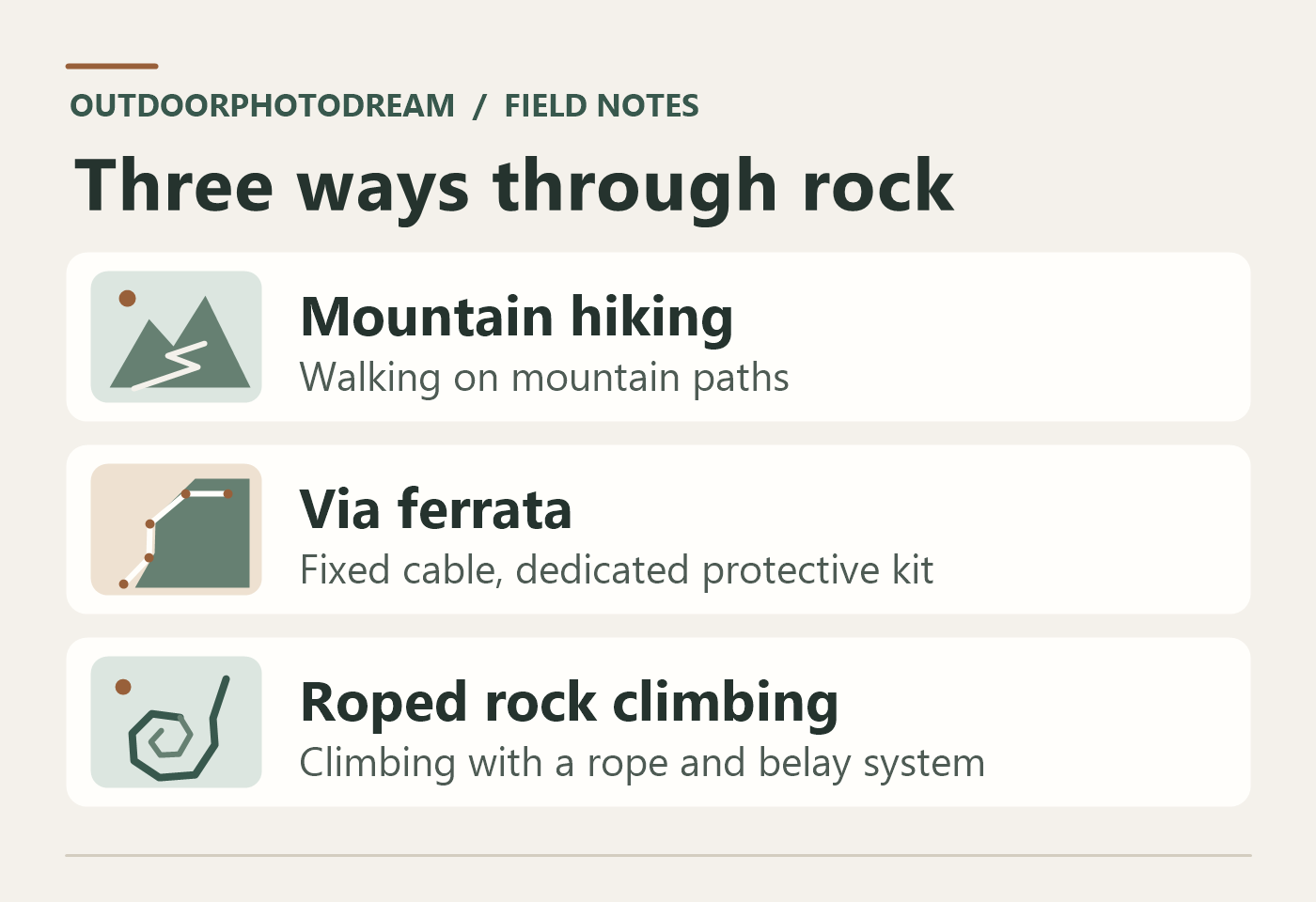
Compare the terrain and equipment
| Activity | Typical terrain | Core distinction |
|---|---|---|
| Hiking | Marked paths and mountain trails | Walking, with difficulty depending on terrain |
| Via ferrata | Rock faces and exposed terrain fitted with fixed protection | Specialized equipment and movement techniques are essential |
| Roped rock climbing | Climbing routes, often without a permanent cable along the line | Rope systems, belaying and climbing skills differ significantly |
Grades & Exposure
One of the most confusing things for visitors is that via ferrata grading systems vary by country and guidebook. You may see Austrian/German-style letters A to E or F, the Italian CAI scale (F, PD, D, TD, ED), or other local systems. These cannot always be compared perfectly by simply matching letters. The UIAA and German Alpine Club (DAV) describe the different approaches to grading. UIAA grading overview · DAV difficulty explanation
For a rough illustration, within the commonly used Austrian letter system:
| Grade | Broad character | Suitable for a first attempt? |
|---|---|---|
| A / A–B | Comparatively easy equipped terrain, possibly exposed | Potentially, with qualified instruction and a suitable route |
| B | Steeper, more sustained and potentially exposed | Depends strongly on the route and the person’s training |
| C | Steep sections demanding strength and technique | Generally not a first independent outing |
| D and above | Very demanding to extremely difficult terrain | For well-prepared, experienced participants |
These descriptions are not universal conversions or a guarantee of safety. A route with one grade-C obstacle can feel very different from a sustained grade-C climb. A long approach, altitude or a difficult descent can make two routes with the same grade very different days.
Grade is only part of the story
Before choosing any route, assess all of the following:
- Technical grade — how difficult is the hardest section?
- Length and physical effort — how long are you actually on the cable?
- Exposure — are there steep drops, traverses or airy bridges?
- Approach and descent — are they straightforward hiking or serious alpine terrain?
- Altitude and weather — could snow, ice, wind or storms make the route unsafe?
- Commitment — is there a realistic place to retreat, or must you finish once started?
A “beginner-friendly” route should be selected by someone who understands all six factors, not just the grade displayed on a website.
Equipment & Risk
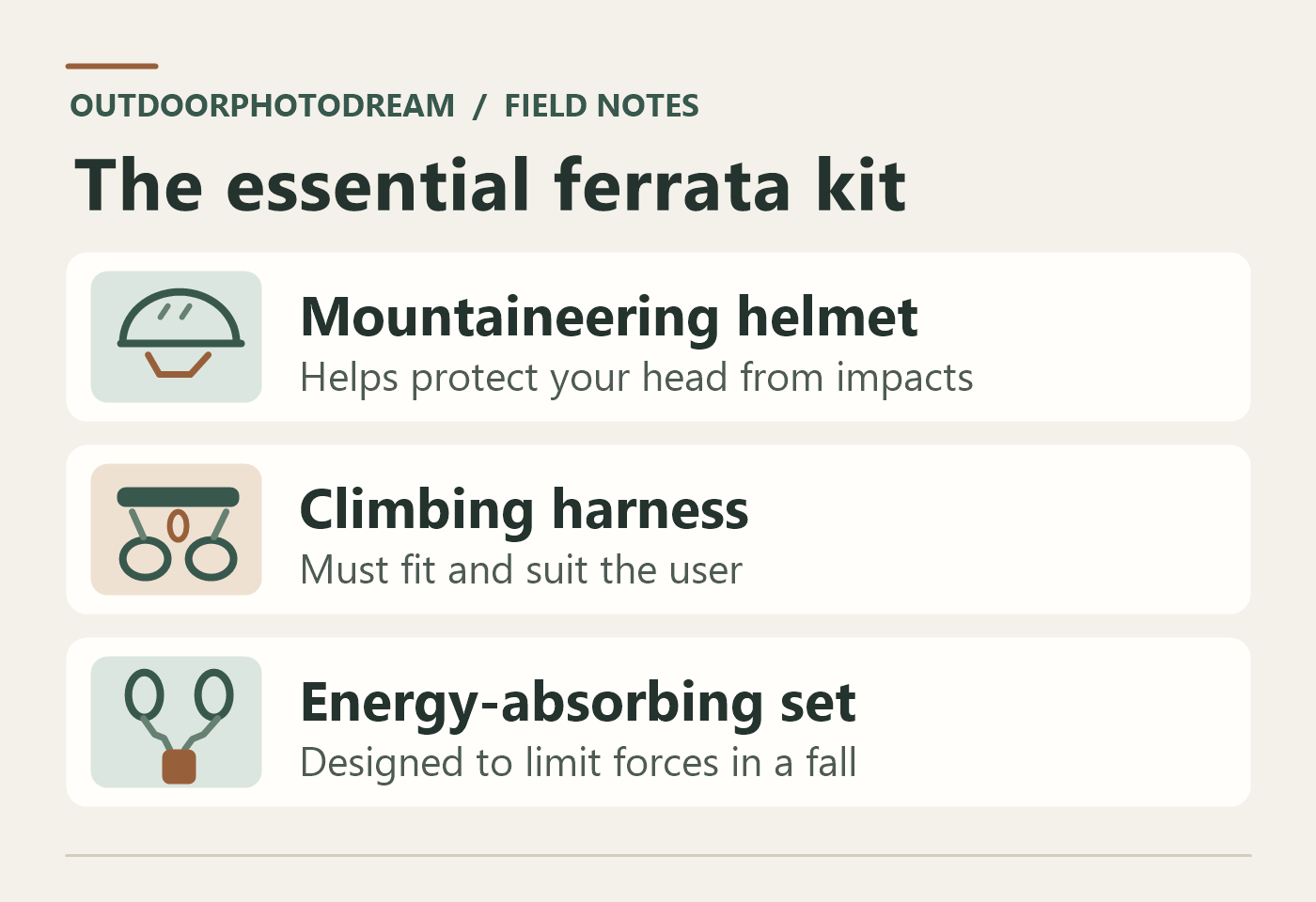
The three core items are a climbing harness, a suitable mountaineering helmet and a modern via ferrata set with an energy absorber. The German Alpine Club lists these as standard equipment. DAV equipment guide
| Equipment | Why it matters |
|---|---|
| Climbing harness | Connects you to the via ferrata system through the correct attachment point |
| Modern energy-absorbing via ferrata set | Dedicated lanyard and connectors designed to limit fall forces within its specified operating range |
| Mountaineering helmet | Protection from falling rocks and impacts against rock or equipment |
| Suitable approach footwear | Traction and support on rock, scree and the descent trail |
| Via ferrata gloves | Help protect hands and improve comfort on steel cables |
| Weather layers, water, food and first-aid essentials | Necessary for a complete mountain day—not just the protected section |
| Map, charged phone and emergency plan | Help you respond if the itinerary takes longer or conditions change |
Choose a dedicated via ferrata set certified to EN 958. The UIAA 128 safety standard adds requirements to the European standard. Check the specific manufacturer’s documentation for compatible equipment and the user weight range. An ordinary sling or improvised lanyard can transmit dangerous forces. If the absorber deploys, retire the set and follow the manufacturer’s guidance after any fall or suspected damage.
For a first guided outing, ask whether the organiser supplies correctly sized, inspected equipment and instruction. Renting or using professionally supplied equipment may make more sense than buying everything before you know whether you enjoy the activity.
What the Cable and Absorber Do
The fixed cable is one part of a system designed to reduce some consequences of a fall when used with compatible personal equipment and the right technique.
A modern via ferrata lanyard generally has two connectors and an energy absorber. During progression, the connectors are managed along the installed cable and transferred past its anchors using a procedure taught by a qualified instructor. Safe spacing from other people is essential. Never attempt to learn the connection sequence for the first time while hanging above a drop.
An energy absorber is a last line of protection. Preventing a fall remains the aim. On ferratas, a falling climber may strike steel steps, rocks or another person before the system arrests the fall. The DAV explicitly emphasizes that preventing falls remains the objective. DAV route planning and fall risks
Use the equipment as supplied and follow the instructions for the exact model. Petzl’s guidance explains why configurations that obstruct absorber deployment are dangerous.
Practise fitting, changes at anchors, spacing, rest techniques and emergency response on safe ground with a qualified instructor before the route.
Plan Your First Day
1. Start with a guided introduction
For your first via ferrata, book a session with a qualified mountain guide authorized to conduct the activity. In Italy, look for a properly qualified Guida Alpina and verify their credentials through the regional register. In the Dolomites, the Veneto register of Alpine Guides is one example. A good guide can select an appropriate route, inspect your equipment, teach the essential techniques and assess the group’s abilities. See the Italian Mountain Guides Association’s professional profiles.
2. Tell the guide what you have—and haven’t—done before
Share your experience of hiking, scrambling, climbing and exposed trails. Be honest about fitness, vertigo and any concern about heights. A professional needs that information to choose a realistic introduction.
3. Learn the equipment on safe ground
Before approaching the protected route, practise with the guide how the equipment fits and works. Build confidence with the equipment before the terrain becomes exposed.
4. Choose a short route with a straightforward descent
For a first experience, a short and well-maintained introductory ferrata is usually more suitable than a famous, isolated Dolomites summit. A manageable approach, modest commitment and clear descent are as important as the advertised technical grade.
5. Check the weather and local conditions
Exposed ridges offer little shelter from thunderstorms. Do not start when storms are forecast or developing. Wet rock, lingering snow, ice and high winds can make an otherwise manageable outing unsafe. Check official closures and local reports before travelling. Never enter a route with visibly damaged cables or anchors. Leave technical assessment of fixed equipment to a qualified professional. DAV: 10 via ferrata recommendations
6. Move steadily and respect other people
Do not rush, overtake in an awkward position, knock stones onto those below or crowd another climber at a cable section. Keep the spacing your guide teaches you and communicate clearly.
7. Accept that turning back can be the right decision
If you feel exhausted, unsafe or overwhelmed, say so before entering a section from which retreat is difficult. Agree on the decision to stop with your guide while you still have a safe option.
What to Ask Before You Book
- Which professional will lead the outing, and what qualification do they hold?
- How long are the approach, equipped part and descent?
- Is the equipment supplied, and will it be checked and fitted before leaving safe ground?
- What is the alternative if weather, crowding or a closure changes the plan?
Heights & Children
If You Are Worried About Heights
It depends on what “afraid” means for you. Feeling nervous at an exposed viewpoint is common, and some people gradually become more comfortable with supported instruction. But severe vertigo, panic or the inability to move confidently around drops is a genuine safety concern, particularly on routes with few escape possibilities.
If you are unsure, tell the guide before booking. They may recommend a low-commitment introduction on safe terrain, or a different activity altogether. There is no shame in deciding that a spectacular panoramic hiking trail is more enjoyable than a vertical route.
If a Child Wants to Join
Some children and teenagers can participate in carefully selected routes under specialist supervision, but the decision cannot be based on age alone. Size, the fit and approved operating range of the energy absorber, ability to understand instructions, stamina and additional rope protection requirements can all matter. A standard adult kit may be unsuitable for a smaller child.
Have an appropriately qualified guide who works with children assess the individual, the equipment and the route before booking. The DAV provides dedicated guidance on via ferrata with children and teenagers.
In the Dolomites
The Dolomites are famous for dramatic rock towers, narrow ledges and extraordinary mountain views. Protected routes give suitably prepared visitors another way to experience this terrain. The region also has a strong historical connection with mountain warfare during the First World War, when soldiers built paths, ladders, tunnels and other infrastructure in difficult mountain terrain.
Today, some Dolomite ferratas follow or intersect historic military routes, while others are modern recreational installations. Not every ferrata originated as a wartime route, and not every military path is a modern ferrata. Understanding the difference adds depth to the experience.
But the setting can be misleading: a beautiful, famous Dolomite ferrata is not necessarily suitable for a beginner. Altitude, approach time, exposure, descent and changing weather often make these routes more serious than a short valley ferrata with an equivalent technical grade.
If you are visiting the Dolomites for the first time, begin with the experience rather than a famous summit name: ask a qualified mountain guide to select a suitable introduction based on your abilities and the conditions that day.
For an example of how the ordinary trails and technical routes differ around one destination, see the Tre Cime guide’s section on history and via ferratas.
Scenic Hiking Alternatives
That’s completely fine. The Dolomites offer some of the world’s most memorable mountain scenery without entering technical or protected climbing terrain. Meadow trails at Alpe di Siusi and Pralongià, mountain-hut walks in the Dolomites, forest paths and scenic high-level hikes can all deliver a rich experience with fewer technical demands—provided you still select routes appropriate to your ability and the conditions.
At OutdoorPhotoDream, we focus on helping guests discover landscapes through private hiking and photography experiences. If your interests lean toward the scenery, light and quieter side of the mountains, explore our Dolomites Hiking Experiences. If your goal is specifically to learn via ferrata, seek an appropriately qualified mountain guide for that technical activity.
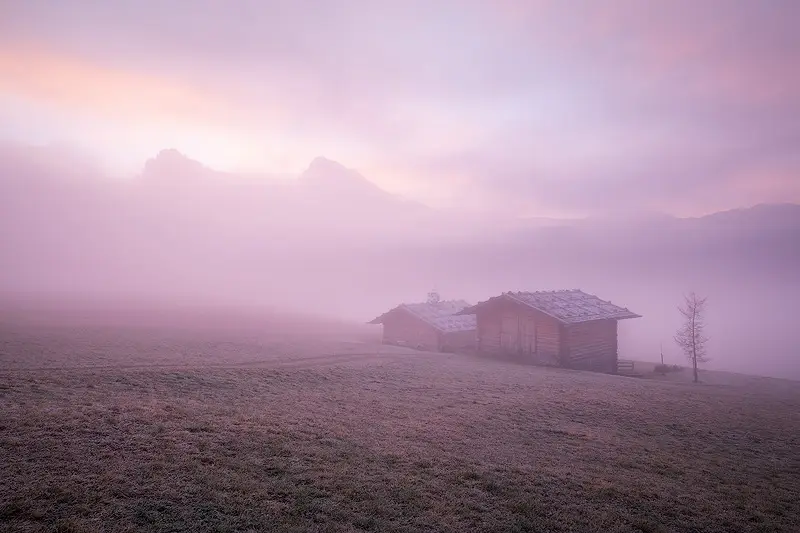
For a private hiking outing, see the Alpe di Siusi Experience and choose a route with your hiking guide according to the season and conditions.
Common First-Day Mistakes
- Choosing a route only by its grade. A/B or B says little about the length, descent or isolation.
- Assuming the cable makes falling safe. A fall can still cause serious injury.
- Using improvised or incompatible equipment. Correct, modern, inspected equipment is fundamental.
- Underestimating the descent. The ferrata is only one part of the mountain itinerary.
- Starting too late. Extra time for learning, queues or slower progress can leave you exposed to afternoon storms.
- Ignoring weather, snow and wet rock. These factors can make a modestly graded route unsuitable.
- Following someone more experienced without proper instruction. Being accompanied is not the same as being competently supervised.
- Pushing on when afraid or exhausted. Ask for help early, before the situation becomes harder to manage.
Via Ferrata FAQ
Is via ferrata suitable for beginners?
Some short, appropriately selected routes are suitable as guided first experiences. Not all protected routes are beginner-friendly, and proper equipment and instruction remain essential.
Is via ferrata the same as rock climbing?
No. Via ferrata uses permanently installed cables and other aids, while rock climbing involves different movement and protection systems. Both can be physically and technically demanding.
Do you need a helmet and harness?
Yes. A suitable mountaineering helmet, climbing harness and modern energy-absorbing via ferrata set are standard essential equipment.
Can you do a via ferrata alone?
A first-timer should not attempt a via ferrata alone. Learn the techniques through a course or with a qualified mountain guide. Even experienced participants need to assess conditions, route commitment and emergency options carefully.
What should you wear?
Choose durable outdoor clothing, suitable mountain footwear, weather layers and gloves. The most important items, however, remain properly fitted technical protective equipment and the knowledge to use it.
Are via ferratas dangerous?
They involve genuine fall, impact, rockfall, weather and exposure hazards. Good instruction, appropriate route choice, suitable equipment and conservative decisions reduce risk but cannot remove it.
How fit do you need to be for a via ferrata?
The answer depends on the route, including its approach, sustained climbing and descent. A beginner should be comfortable with the advertised walking time and physical effort, and should describe their fitness and experience honestly to the qualified guide selecting the route.
Which Dolomites via ferrata is best for my first time?
There is no single universally suitable answer. The best choice depends on the participant’s height tolerance, fitness, experience, time available and real-time mountain conditions. A qualified guide can recommend an appropriate introductory route.
Explore with OutdoorPhotoDream
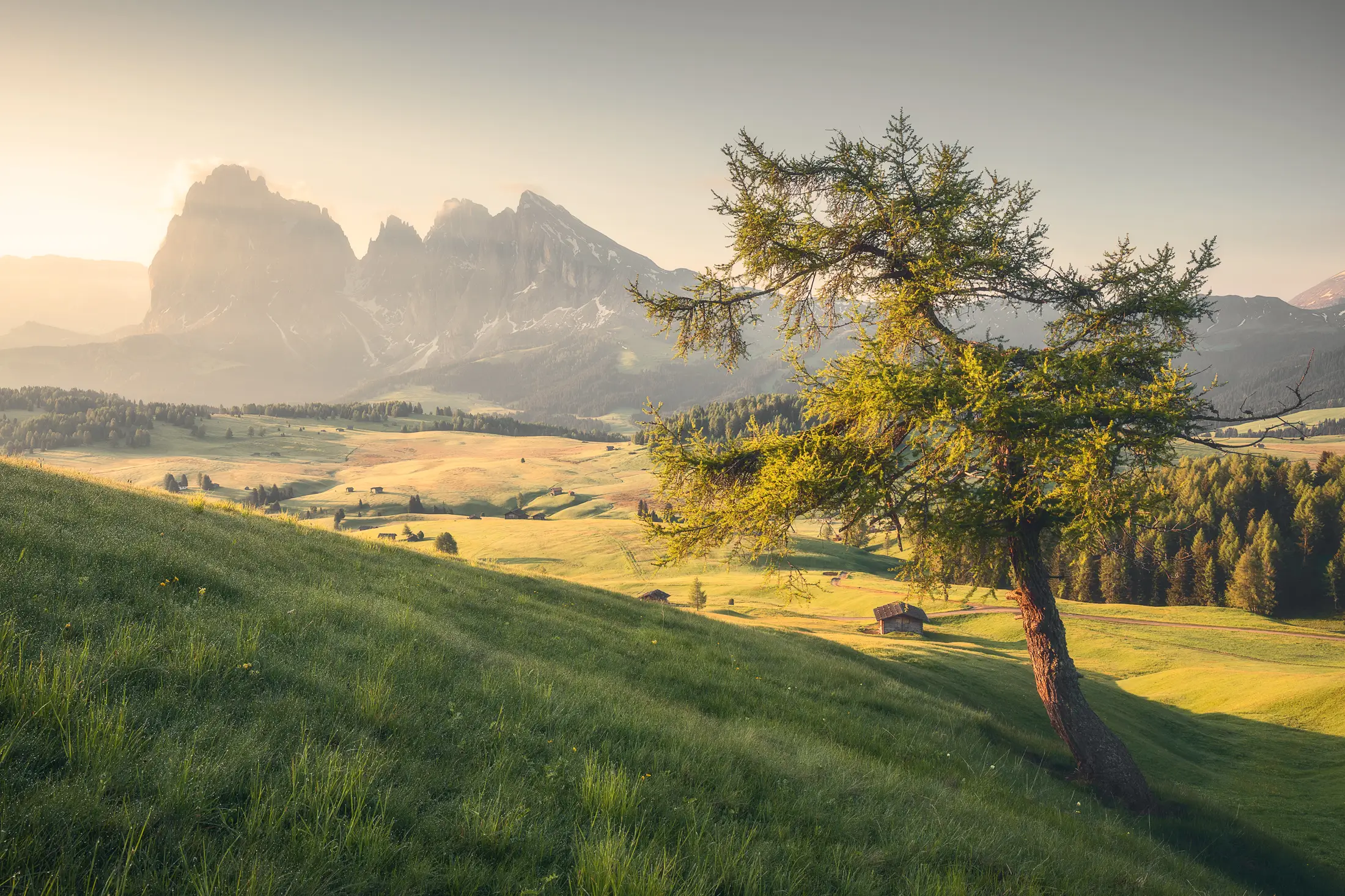
Guided Hiking
Guided Hiking at Alpe di Siusi
Walk the Alpe di Siusi plateau on a private guided hike, with scenic viewpoints and time for photography when you want it.
Explore Hiking Experience
Private Tours
Private Dolomites Photography Tour
Plan a private Dolomites photography trip around your interests, the available light and suitable access.
Explore Private Tour
Group Photography Tours
Dolomites Autumn Photography Tour
Explore the changing autumn light and landscapes of the Dolomites with a small group.
Explore Photo Tour
About the author
Federico Antonello
Related Field Notes

Tre Cime di Lavaredo: Hiking Routes, Parking & Visiting Guide
Plan a visit to the Three Peaks with parking and shuttle advice, a step-by-step guide to the classic loop, routes from the valleys and Federico’s photography tips.
Cortina d’Ampezzo Travel Guide: Best Things to Do, Hiking, Lakes and Local Tips
Plan a trip to Cortina d’Ampezzo with hikes, lakes, seasonal access advice and a flexible three-day itinerary for the eastern Dolomites.
My Favourite Mountain Huts in the Dolomites for Sunrise, Sunset and Photography
Discover some of the best mountain huts in the Dolomites for sunrise, sunset and landscape photography. From iconic locations to hidden gems, these are my personal favourites.


